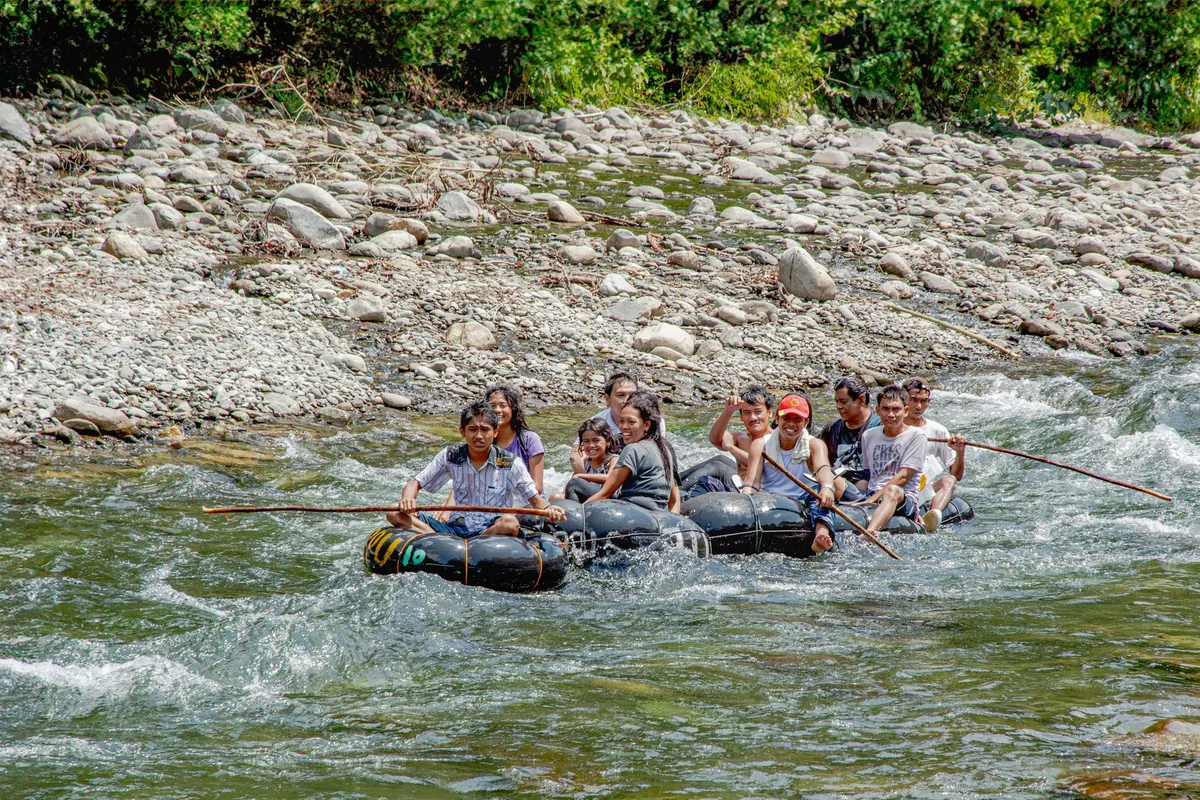
The tube bucks, the current grabs you, and suddenly you are underwater with a mouthful of river. Falling out of a tube is rarely graceful, and it usually happens in the same kinds of places: a choppy chute, a rock garden, or a spot where two currents collide and the tube folds underneath you. What turns that moment into a mild inconvenience instead of a genuinely frightening five minutes is what you do in the first thirty seconds.
Breathe First, Swim Second
Your instinct will be to lunge for the tube. Resist it for a second. Get your face clear of the water, exhale slowly through pursed lips, and take a real breath. Cold water on your face triggers a gasp reflex that can make you suck in water exactly when you need air, so blowing out deliberately is a technique, not a nicety.
Then look around. Where is the tube? Where is the nearest safe shore? Where is your group? Answer those three questions before you move a muscle. The tube floats — it cannot sink. If it drifts twenty feet downstream while you get your head together, that is fine. It will still be floating when you catch up to it.
Some people find it helps to say the next step out loud. "Feet downstream. Feet downstream." A few plain words crowd out the panic.
Float Feet-First, Face Up
This is the position you want to hold any time you are out of the tube in moving water:
- On your back, face up, head clear of the water
- Feet downstream, toes out of the water, ankles flexed
- Knees slightly bent, never locked
- Arms spread for balance, hands ready to fend off a rock
Why feet first? Because you can see where you are going, your shoes and legs take the impact of anything you bump, and if you do hit an obstacle, your feet push you over it instead of your head taking the hit. Float this way by default, not as a last resort.
Use the current instead of fighting it
If you need to reach a bank, do not swim straight across. Angle your body downstream and slightly toward shore — a ferry angle — and use short, steady strokes. You will cross the river faster and with far less energy than trying to beat the current head-on.
Pick your target with some thought. Inside bends are usually shallow and slow; outside bends are deeper and faster. Aim for the inside of a curve, a wide calm pool below a riffle, or any pocket of still water behind a rock or a fallen log.
Never Stand Up in Moving Water
This is the rule worth memorizing above all others. When your feet touch the bottom in current, they can wedge between rocks. The current keeps pushing your body downstream while your foot stays put, and it holds you under. It happens in water that looks knee-deep.
So keep your feet floating and your body moving until you reach genuinely shallow, slow water — a flat stretch where you can see the bottom and feel no push against your legs. Then stand, and stand deliberately, one hand on the tube if you still have it.
Getting Back In: Go Belly-First
Most people try to climb back in feet-first and exhaust themselves in fifteen seconds. Forget that. Getting into a tube from the water works like sliding onto a dock: you go belly-first, and you use the tube's own buoyancy to help you.
- Get alongside it. Keep one hand on the handle or a strap. If the tube is racing away, do not chase it — float on your back and wait for a slow stretch, or let it go.
- Reach across the top. Put both hands on the far rim and press straight down. This is the key move: pressing the far side down tips the near side up toward you.
- Kick hard, once or twice. A strong flutter kick with your chin up does most of the work.
- Land your belly, not your knees. Drape your chest and stomach over the near rim. Knees and feet will not get you up; your midsection will.
- Sprawl and rotate. Lie across the tube, then swing your hips around so you slide down into the hole with your legs trailing.
- Sit deep and check your line. Back against the tube wall, feet downstream, and look ahead before you relax.
If the first attempt fails, stop. Float on your back, take a few breaths, and try again. Tired arms are the real hazard here, not the tube.
If the seal slide is not working, flip the tube over so the hole faces down, haul yourself on top of the inflated side, and ride it like a raft until you reach calmer water. Getting out of the current matters more than getting back in the seat correctly.
Sometimes You Should Let the Tube Go
There are places where chasing your tube is the wrong decision: anywhere it is heading toward a fallen tree at the bank, a bridge piling, a rock the water pours through, or a low branch. Those are the hazards that trap people. Swim for shore and sort out the tube later. It is replaceable. You are not.
Practice Somewhere That Will Not Punish You
Recovery is a skill, and skills are built in easy water. Before your next real trip, spend fifteen minutes in a slow, waist-deep stretch and rehearse:
- Flipping your tube and climbing back on, three or four times in a row
- Rolling from your stomach to a seated position without touching bottom
- Holding the defensive float, feet up, for a full thirty seconds
- Ferrying across the current at an angle instead of straight across
Do it until the moves feel boring. Boring is what you want when the water is loud and cold and your group is scattered downstream.
Before You Push Off
A little preparation makes all of the above far easier. Wear a properly buckled life jacket — not one you are sitting on. Choose shoes that stay on your feet, which rules out loose flip-flops. Clip a whistle to your vest so you can signal without shouting. Never tie yourself to a tube with a rope or leash; if it snags, you go with it.
Float with at least one other person, check the day's flow level and weather with a local outfitter before you put in, and tell someone where you are launching and where you plan to take out. If you have a heart condition, a recent shoulder injury, or another health concern, talk to a doctor before you go, and treat cold water seriously — a long swim in cold water is exhausting in a way warm water is not.
Keep your feet downstream. Do not stand up in the current. Get back in belly-first, and give yourself permission to let the tube go when the water tells you to. Practice those four things and falling out becomes an inconvenience you handle in thirty seconds, not the part of the trip you remember for the wrong reasons.
Photo: Man Fong Wong / Pexels