Ask a parent who has tubed a river with a kid what they remember, and it is rarely the floating. It is the twenty minutes before, when a sandal went downstream without its owner and a life jacket got buckled onto the wrong child. Tubing with kids is genuinely fun, but it rewards planning far more than enthusiasm. Here is how to judge when a child is ready, how to fit a life jacket that will actually hold their head up, and how to pick a stretch of river that forgives first-trip mistakes.
Readiness Is About Skills, Not Birthdays
There is no universal age at which a child is ready to tube a river. Outfitters set their own minimums, and those minimums have as much to do with liability and shuttle logistics as they do with any individual kid. Ask what the minimum is, respect it, then make your own call based on what you have seen your child do in water.
- Comfort with water in the face. A kid who panics when splashed will panic when the river splashes them, and panic in moving water is the thing you are trying to avoid.
- Can float on their back on command. Not a polished swimmer — just able to roll onto their back, keep feet up, and stay calm for a few seconds.
- Follows a stop instruction the first time. If "stop, stay right there" takes three repeats on land, it will not land on water.
- Wears the life jacket without a fight. Fussing turns into tugging, and tugging turns into a loose jacket.
If you are unsure, the answer is not "no forever." It is smaller water. A calm stretch of a local river, or even a lake with a gentle current, tells you everything you need to know for next summer. Preschoolers are generally better off in a pool or a shallow swimming hole than on any river with current. If your child has a medical condition, or you have questions about how cold water might affect them, check with their pediatrician before the trip.
Fitting a Child's Life Jacket Properly
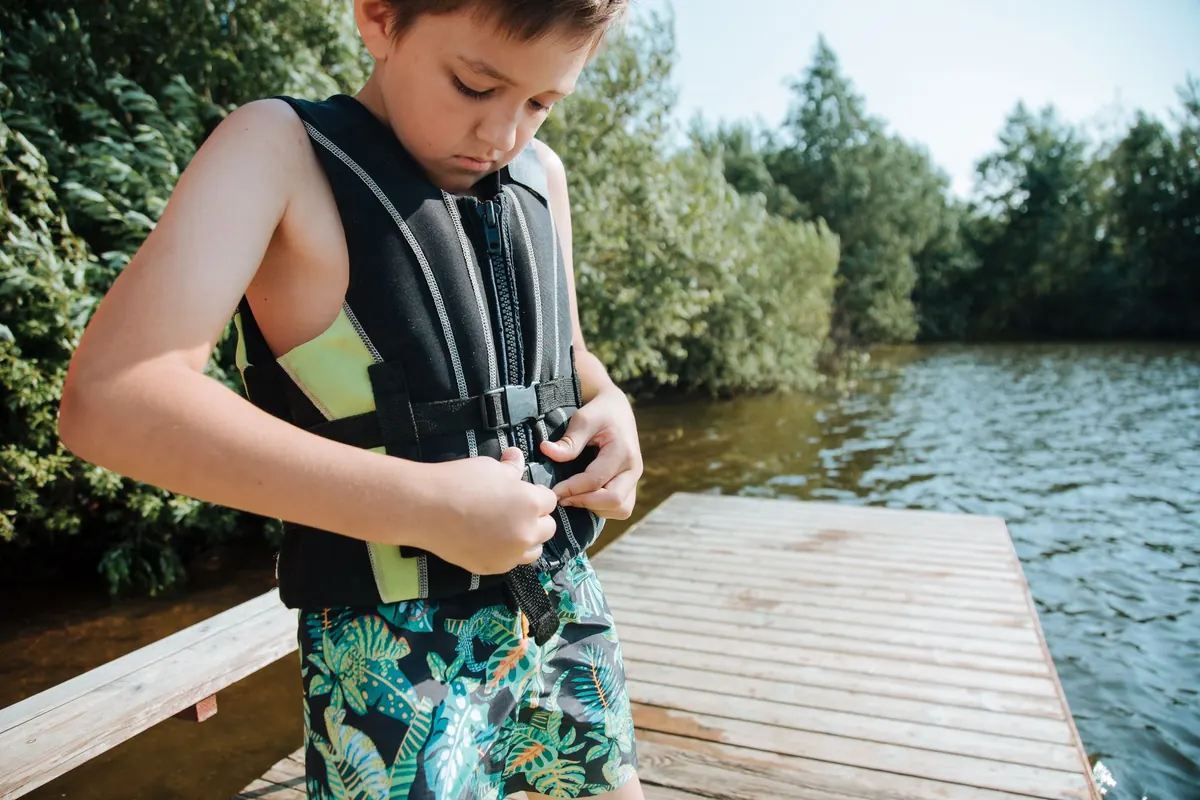
A child's life jacket is not a scaled-down adult jacket. It is cut shorter through the torso and usually built with a collar that helps tip a floating child onto their back. Look for one approved by the relevant authority in your country, rated for your child's weight, and fitted to that child — not "close enough."
The five-step fit test
- Put it on over the swimsuit or thin shirt they will actually wear in the water, and fasten every buckle and zipper.
- Snug the side and shoulder straps until the jacket is firm against the body. You should be able to slide a flat hand under a strap, not a fist.
- Lift the child by the shoulders of the jacket. A good fit rises only slightly and settles back down. If the jacket slides up over the chin and ears, it is too big, and no amount of tightening will fix that.
- Have them raise both arms straight up while you press down on the top of the jacket. If it comes up to their nose, size down.
- Use the crotch strap if the jacket has one. It is the single feature that keeps a jacket from riding up on a small body.
Details that get missed
- A grab handle on the back makes hauling a kid out of the water far easier.
- Bright colors help you spot them from the bank and in a cluster of tubes.
- Pool noodles, arm floaties, and inflatable rings are toys. They are never a substitute for a life jacket on a river.
- Test the jacket in shallow water before the trip, so your child feels what it does before they need it.
Rules about life jackets for children vary by state, province, and the agency managing the river. Many places require kids to wear an approved jacket, and some set age thresholds. Check with the local outfitter or land manager, and treat the rule as the floor rather than the standard.
Choosing a Shallow, Slow Stretch
Most rough family float trips are caused by the wrong section of river, not by the kids. Shallow and slow needs to hold true for the whole run, not just the put-in.
- Shallow: an adult can stand up through most of it. Waist-deep is fine in slow water; long stretches where nobody can touch bottom are not.
- Slow: the surface moves, but there is no white water, no wave trains, no drops, and no water rushing under anything.
- Clear of hazards: no low-head dams, which are dangerous and often invisible from upstream, and no fallen trees or logjams collecting debris.
- Easy access: a put-in and take-out you
Photo: Ron Lach / Pexels